
How Planeto helped Ström SA bring geothermal energy to a historic UNESCO site
Using Planeto's software, Ström SA developed a groundbreaking sustainable solution that could revolutionize energy systems for thousands of historic villages worldwide.
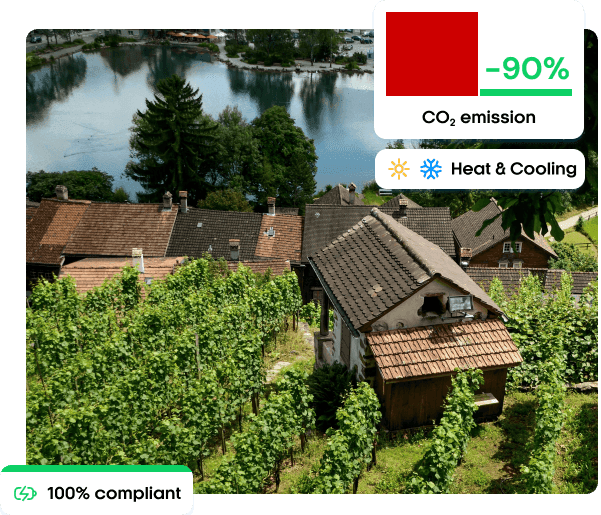
- 65%Less energy for pumping
- 1 110mSingle-tube thermal loop
- 50%Less geothermal boreholes
Company details
STRÖM SA is an energy engineering office that brings and deploys optimized energy systems using different sort of renewable heating and cooling solutions. They offer smart homes and eco energy solutions services for personal houses and industrial environments.
The challenge
The village of Grandvaux (CH) is a UNESCO World Heritage site. This historic village, nestled on the steep slopes above Lake Léman, overlooks surrounding vineyards. Decarbonizing such a site poses unique challenges due to heritage preservation requirements, limited thermal resources, and the low energy efficiency of historic buildings.
The village comprises 67 buildings, mainly built between the 15th and 19th centuries, with a total heat demand of 2.3 GWh/year.
To tackle this challenging case, our client Ström Energy, with support from the Swiss Federal Office of Energy, designed a novel 5th generation district heating and cooling system using shallow geothermal wells.
The solution
To address these challenges, Planeto's Software Tessa helped Ström SA to design the new DHC network for this historic 67-building village.
1. Use of a single-tube loop
The single-pipe loop concept reduces construction costs, network pressure losses, operating costs, the number of probes and energy recovery.
A 5th-generation DHC network saves space and energy by using a low-temperature thermal vector (between 3 and 15°C) with uninsulated single-tube pipes, to which buildings are fed in series via a heat pump (HP) — and not via a heat exchanger, as is the case with 3rd- and 4th-generation DHC.
Each building produces its own hot water and heat, as well as cooling. An important characteristic from 5th-generation networks as cooling demands are going to increase in the next years (by the year 2069 demands could increase by +4'840%).
2. Re-using heat loss
5th-generation DHC networks make it possible to recycle consumption waste that can be used directly to recharge geothermal probes.
3. Reduction of the total number of boreholes
In order to optimize the borehole configuration and minimize the long-term thermal resistance of the soil, Planeto used an optimization strategy proving that too dense a group leads to a reduction in energy performance due to significant thermal interference between probes.
The layout of the 64 boreholes presented is optimally distributed, maximizing the potential for efficient extraction of heat from the boreholes.
This is mainly possible due to the spacing between boreholes along the roads, limiting the interaction between probes and allowing the valorization of additional regenerative sources due to the network's low temperature. These decentralized energy recovery systems are installed to regenerate the network during the warm period of the year, allowing energy storage in the boreholes.
The results
100% Compliance with regulations on geothermal heat extraction
Ström SA selected Planeto's solution for its unique ability to simulate low temperature networks simultaneously with geothermal probe fields over multiple decades. This capability was essential to validate the design's compliance with regulations on geothermal heat extraction.
The village's heritage was preserved
Shaped by man since the 12th century, Lavaux is famous for its terraced vineyards and vines planted as far back as Roman times.
The many laws governing land-use planning at federal, cantonal and municipal level are exceptionally protective. This landscape is even enshrined in the Vaud Constitution. These strong measures have led to UNESCO recognizing Lavaux as a World Heritage Site.
It is in this context that Planeto delivered further value through its optimisation algorithms which could reduce the geothermal field size by making use of thermal regeneration and respected the village's laws and heritage.
→ Access the official report here.
InfraWatt Innovation award winner — 2026
At the 2026 District Heating Forum, InfraWatt presented the 2026 Innovation Award – Thermal Networks, recognizing this project as a decisive contribution to the decarbonization of heat and cooling supply in Switzerland.

 Haute-Sorne - Switzerland